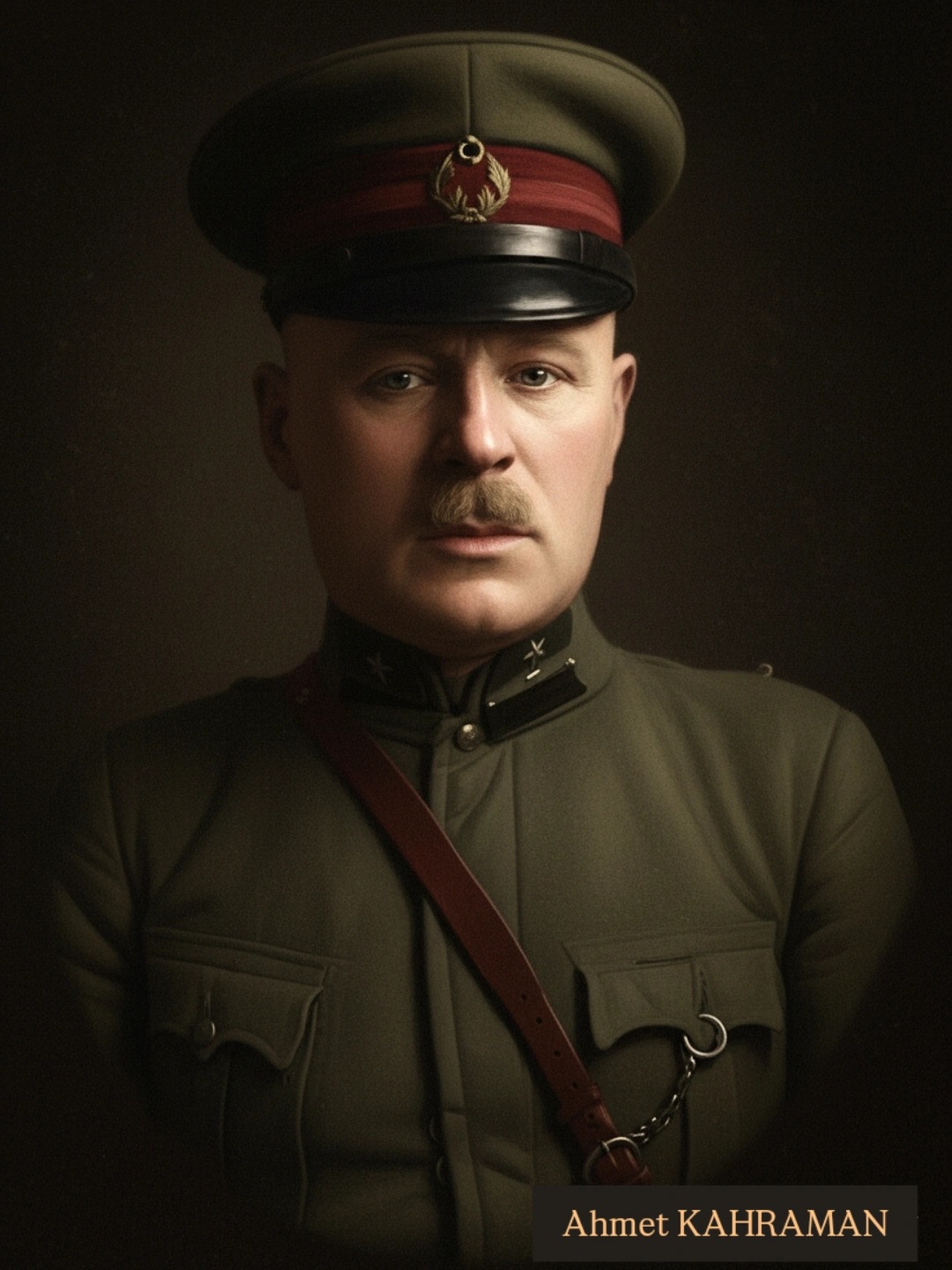
Ahmet Kahraman
The Long Road Home: The Story of Ahmet Kahraman (1866–1952)
Some lives survive in official records. Others survive in memory. Ahmet Kahraman survived in both.
In military documents, his life appears in only a few lines: an Ottoman artillery officer from Erzincan, captured during the Battle of Sarikamish in January 1915, returning to his homeland years later after captivity and exile, and passing away in Ankara in 1952.
Yet behind those few lines lies a much larger story — one that stretches from the snow-covered mountains of eastern Anatolia to the vast interior of Russia, from the uncertainty of wartime captivity to the cities of Turkestan, and finally back to a homeland that had changed forever.
At the beginning of that journey stood a simple farewell.
Before he left for war, his mother, Mahbube, prepared food for the road: kete and hard bread packed into a saddlebag. Then she said something he would remember for the rest of his life:
"If you return and find that I am gone, visit my grave and let me know that you came home."
Neither mother nor son knew how long that separation would last.
Before Sarikamish
Ahmet Kahraman was born in 1866 in the village of Selüke near Erzincan, in eastern Anatolia. The son of İsmail and Mahbube, he entered military service at a young age and spent decades in the Ottoman artillery. When the First World War began, he was no inexperienced recruit. He was already a seasoned officer who understood responsibility, hardship, and the weight of leaving family behind.
By late 1914 he was serving as a supply officer with the headquarters of the Ottoman 29th Division, responsible for logistics and provisions. It was a position that placed him close to one of the most tragic campaigns of the war.
The Winter of Sarikamish
For military historians, Sarikamish is remembered as a disastrous winter campaign fought between the Ottoman and Russian armies in the Caucasus. For Ahmet Kahraman, it remained something else. A winter. A winter of endless snow. A winter in which men disappeared into blizzards. A winter in which sleep could become death.
Years later, he reportedly spoke less about military operations than about people. He remembered soldiers trying to survive with inadequate clothing. He remembered men collapsing from exhaustion and cold. He remembered waking those who had fallen asleep beneath bridges because everyone knew what sleep in such weather could mean.
He also remembered the large military cloak he wore. During the coldest nights, several soldiers would gather beneath it, sharing what little warmth they could find.
On 4 January 1915, he was captured by Russian forces. The campaign was over. A new journey had begun.

Captivity
The first phase of captivity appears to have been the hardest. Like thousands of Ottoman prisoners taken on the Caucasus Front, Ahmet Kahraman was transported deep into the Russian Empire. The journey itself became part of the ordeal. He later spoke of overcrowded railway wagons, suffocating conditions, hunger, disease, and relentless cold. Some prisoners did not survive the transport.
The cold remained one of the defining memories of his life. Certain details survived through family recollections. He described confined spaces resembling iron cages, frozen conditions, and the sense of being carried farther and farther away from home.
Yet captivity was not only isolation. At some stage, prisoners were employed in work details in and around towns. He spoke of sweeping streets and cleaning roads. Such memories suggest periods spent near urban settlements rather than exclusively in remote prison camps.
One recollection stands out. According to family memory, a local official noticed that the Ottoman officer rarely left the place where he was held. One day, the official took him on a drive through the town. The story remained with him for decades. Perhaps because captivity deprives a person not only of freedom but also of visibility. For a moment, he was treated not merely as a prisoner, but as a fellow human being.
Escape
The Russian Empire collapsed. Revolution came. Civil war followed. Across Eurasia, borders shifted and old systems dissolved. Somewhere within that turmoil, Ahmet Kahraman made a decision: he would try to return home. He was not alone at first. Several companions joined him, including men from Erzincan.
But the journey south was extraordinarily difficult. Hunger, uncertainty, and distance tested everyone involved. One by one, his companions turned back. Eventually, he continued alone.
Family memory preserves an image that feels almost symbolic: a hand-drawn map hidden inside his boot. Over time the paper wore out, lines faded, and directions became difficult to read. He slept in cemeteries. He endured hunger. He lost his way more than once. But he kept moving. Because this was no longer simply an escape. It had become a journey home.
The Woman Who Helped Him
One memory remained especially vivid throughout his life. Exhausted, hungry, and near collapse, he arrived at a place where a woman took him in. She fed him, allowed him to wash, and gave him clean clothes. Then she said only one sentence:
"My son is a soldier too."
Ahmet Kahraman never forgot her. Perhaps because, in that moment, a stranger reminded him of home.
Samarkand
His route eventually led him into Turkestan. Samarkand. Tashkent. These were not merely places he passed through. They became part of his life. There he appears to have rebuilt himself.
Family recollections suggest that he taught Turkish children, worked as a teacher, and earned money. This detail may help explain another memory he later shared: when he reached Batumi years later, he still carried money hidden inside a glove. For a fugitive traveler crossing continents, such savings were unlikely to have come from captivity alone.
In Samarkand he was no longer merely a prisoner or an escapee. He was once again a teacher, a worker, and a member of a community. People reportedly encouraged him to stay. Others did stay. Many former Ottoman prisoners built new lives across Central Asia and never returned. Ahmet Kahraman chose differently. His story is not only the story of a man who left Erzincan. It is also the story of a man who left Samarkand.
Homecoming
Eventually he reached Batumi, where illness forced him into hospital care. From there he was transferred to Trabzon on the Black Sea coast. On 5 December 1921, nearly seven years after his capture, he returned to the Ottoman homeland that no longer existed. His brothers came to meet him. For years, many had assumed he was dead.
Yet the greatest losses had already occurred. His mother, Mahbube, was gone. His first wife, Lütfiye, was gone. His daughter, Nuriye, was gone. The home he had struggled to reach was not the same home he had left. And yet he had returned.
After the War
Life began again. His sons, İhsan and Veysel, were alive. Later he married Fatma and had two daughters, Şahide and Nahide. Much of what is known about his experiences survived because those memories were preserved and passed down through Nahide Öztopçu. Without that chain of remembrance, many details of his journey would have disappeared forever.
A Human Story
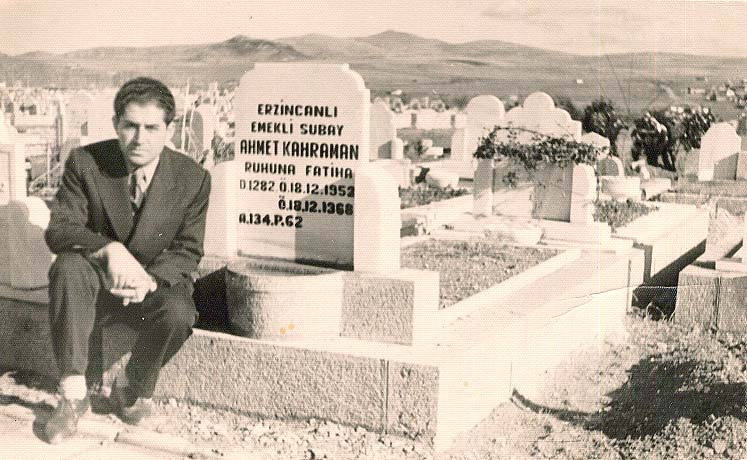
Ahmet Kahraman died in Ankara on 18 December 1952 and was buried in Cebeci Cemetery. He left behind more than military records. He left memories of soldiers gathering beneath a cloak against the cold. He left the image of a fading map hidden in a boot. He left stories of nights spent among graves, of lessons taught in Samarkand, and of money preserved inside a glove through years of uncertainty.
Most of all, he left a reminder that history is not made only of campaigns and treaties. It is also made of people who refuse to abandon the road home.
Many years earlier, his mother had said:
"If you return and find that I am gone, visit my grave and let me know that you came home."
When Ahmet Kahraman finally returned, she was no longer there. But he had kept his promise.
This narrative is based on Ottoman military records, historical research on Ottoman prisoners of war after the Battle of Sarikamish, and oral testimonies preserved across generations by the Öztopçu family and the Erzincan BELGELİĞİ archive.
Historical Notes
Born: 1866, Selüke (Erzincan)
Father: İsmail
Mother: Mahbube
Ottoman Artillery Lieutenant
Supply Officer, 29th Ottoman Division
Captured at Sarikamish: 4 January 1915
Returned to Trabzon: 5 December 1921
Died in Ankara: 18 December 1952
Buried in Cebeci Cemetery