Tuğba Öztopçu:
The Archaeology of the Present and the Stillness of Being
Tuğba Öztopçu’s paintings and
photographic works initially evoke the quiet order of domestic
interiors: tables, fruits, toys, photographs, and plants. Yet this
familiar arrangement of objects reveals a layered visual logic. Her
interiors are not mere depictions of physical space; each object and
surface functions as an archaeological layer of memory and time.
Through everyday objects, Öztopçu constructs a delicate architecture
of temporality, recollection, and personal history.
Palimpsest and Layered Time
Öztopçu’s works can be read as
palimpsests: every surface carries traces of the past and remnants of
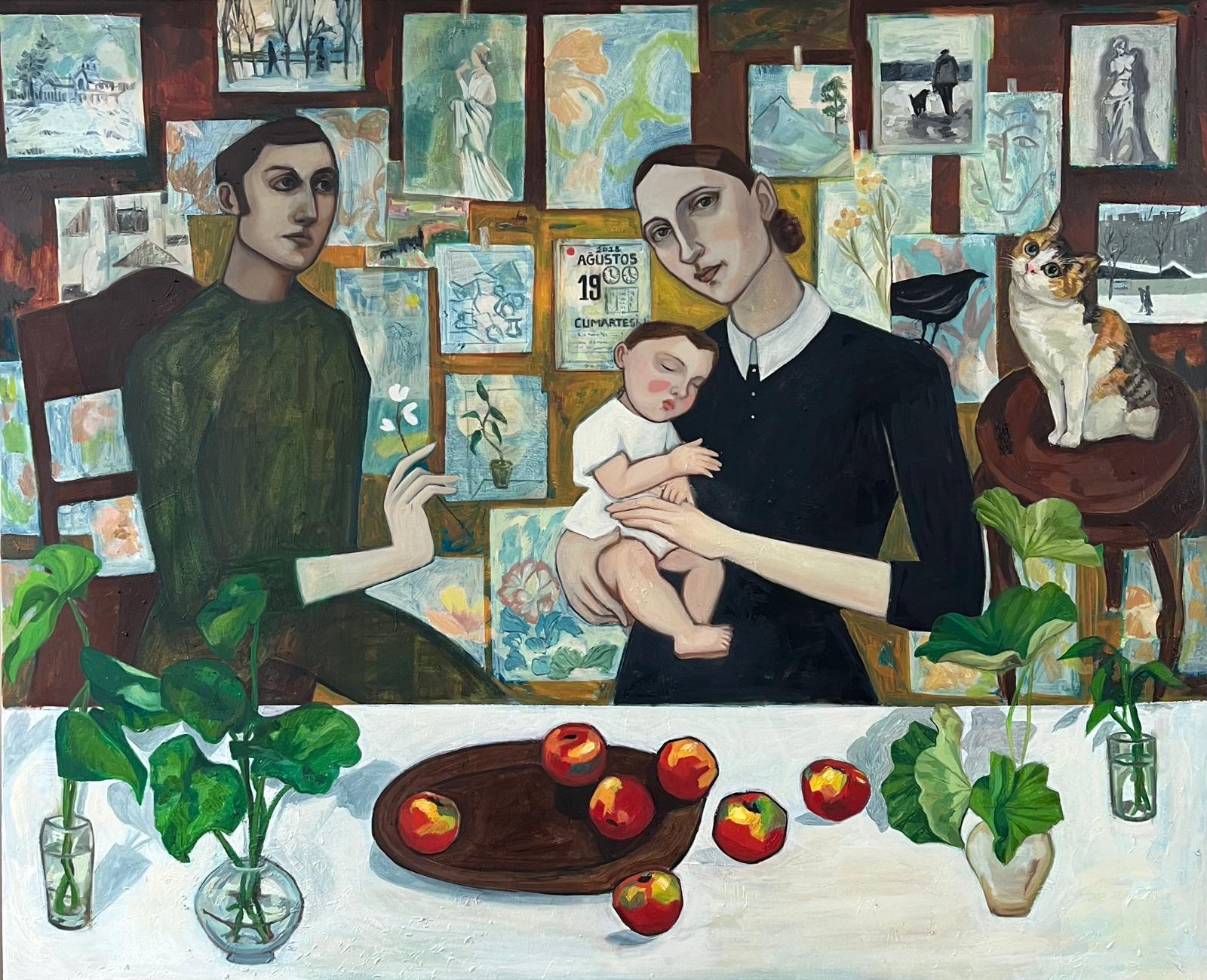
previous drafts. In works such as
Family Portrait, the background wall is more than a room—it
embodies the “layered time” of memory. Smaller paintings, calendar
pages, and photographs are included in the composition as past
iterations of the main scene. Time is not linear but simultaneous;
past, present, and future coexist within the same perceptual field.
This approach aligns directly with Henri Bergson’s philosophy of
duration (durée) and offers a temporal framework resonant with
contemporary global art discourse.
Fictional Space and the Visual Archive
Öztopçu’s interiors do not adhere to
classical perspective. Objects, paintings, and frames overlap, forming
a “stacked plane” that transforms conventional still life into a
visual memory archive. Individual objects are secondary to their
relational whole and silent dialogue. Recurrent motifs—wooden toy
horses, envelopes, vintage photographs, and apples—function not as
decorative details but as markers of time and memory. The horse motif
represents the stasis of the past, while birds and other living
elements introduce attentive stillness, signaling the fragility of
life within these constructed spaces.
Gaze and Hands: The Tension with the
Viewer
Figures occupy the center of Öztopçu’s
interiors. Their direct gaze transforms viewers from passive observers
into witnesses of the scene. Hands, often holding an object—an apple,
a letter, a child—or embracing, act as tactile proof of the mental or
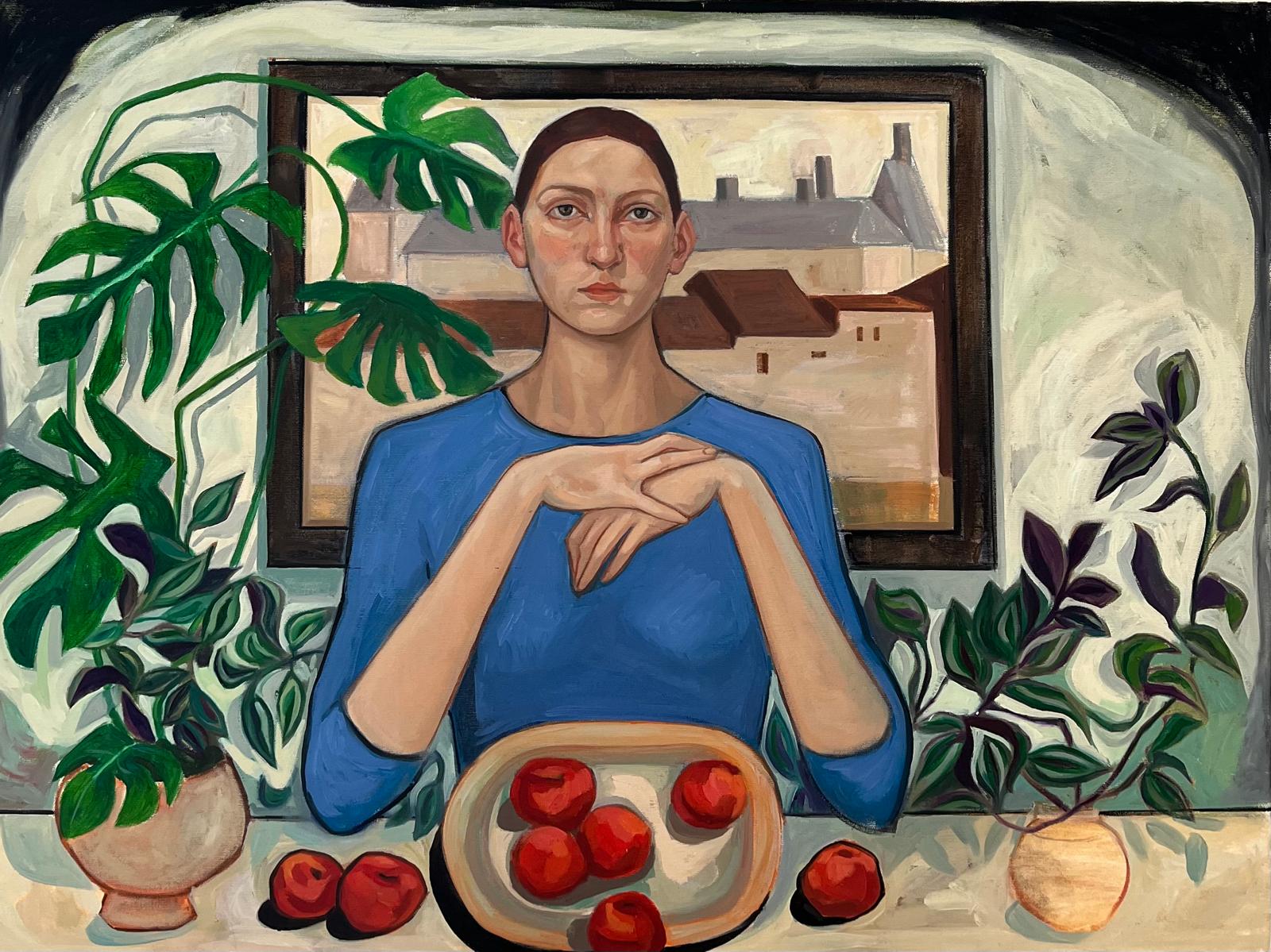
conceptual reality of the space. In
Blue Woman, the static
figure and interlaced hands suspend the flow of time, emphasizing the
interior as an ontological field.
The Acoustics of Silence in Color
Öztopçu applies color in matte, flat
planes: yellows, pinks, greens, and blues radiate without reflecting
light. This planar treatment transforms objects into symbolic forms
and reinforces the interior as a closed, introspective “mindscape.”
Bold black contours act as an intellectual mechanism, containing
emotions and maintaining compositional discipline.
Spatial Laboratory: Photography and
Painting
Her photographic and painterly practices
intersect. Reflections and veils in photographs are translated into
matte color blocks and contours in paintings. Both media freeze
reality through a memory filter, turning it into evidence. This
process manifests Öztopçu’s archival impulse as a form of plastic
poetry.
Universal and Local Balance
Öztopçu integrates universal themes—family,
contemplation, nature—with localized traces. The mother-and-child
motif reinterprets classical iconography in a modern, personal context,
while Monstera leaves and natural objects infuse life into these
frozen, constructed worlds. This synthesis renders her work both
original and comprehensible for international biennials and
exhibitions.
Global Conceptual Significance
Öztopçu’s paintings and photographs
offer high curatorial value for collections and museums concerned with
the fragility of memory and the mental construction of space. Her
approach to stacking and curatorial composition synthesizes
contemporary art’s interest in memory and archive with disciplined
modernist technique. The ontological layering of space and the
monumental stillness of her figures position Tuğba Öztopçu as an
indispensable artist for global exhibitions centered on “Memory and
Silence.”
Tuğba
Öztopçu: The Archaeology of the Present and the Stillness of
Being
Tuğba
Öztopçu’s paintings and photographic works initially evoke the quiet
order of domestic interiors: tables, fruits, toys, photographs, and
plants. Yet this familiar arrangement of objects reveals a layered
visual logic. Her interiors are not mere depictions of physical space;
each object and surface functions as an archaeological layer of memory
and time. Through everyday objects, Öztopçu constructs a delicate
architecture of temporality, recollection, and personal history.
Palimpsest
and Layered Time
Öztopçu’s
works can be read as palimpsests: every surface carries traces of the
past and remnants of previous drafts. In works such as
Family Portrait, the
background wall is more than a room—it embodies the “layered time” of
memory. Smaller paintings, calendar pages, and photographs are
included in the composition as past iterations of the main scene. Time
is not linear but simultaneous; past, present, and future coexist
within the same perceptual field. This approach aligns directly with
Henri Bergson’s philosophy of duration (durée) and offers a temporal
framework resonant with contemporary global art discourse.
Fictional
Space and the Visual Archive
Öztopçu’s
interiors do not adhere to classical perspective. Objects, paintings,
and frames overlap, forming a “stacked plane” that transforms
conventional still life into a visual memory archive. Individual
objects are secondary to their relational whole and silent dialogue.
Recurrent motifs—wooden toy horses, envelopes, vintage photographs,
and apples—function not as decorative details but as markers of time
and memory. The horse motif represents the stasis of the past, while
birds and other living elements introduce attentive stillness,
signaling the fragility of life within these constructed spaces.
Gaze
and Hands: The Tension with the Viewer
Figures
occupy the center of Öztopçu’s interiors. Their direct gaze transforms
viewers from passive observers into witnesses of the scene. Hands,
often holding an object—an apple, a letter, a child—or embracing, act
as tactile proof of the mental or conceptual reality of the space. In
Blue Woman, the static
figure and interlaced hands suspend the flow of time, emphasizing the
interior as an ontological field.
The
Acoustics of Silence in Color
Öztopçu
applies color in matte, flat planes: yellows, pinks, greens, and blues
radiate without reflecting light. This planar treatment transforms
objects into symbolic forms and reinforces the interior as a closed,
introspective “mindscape.” Bold black contours act as an intellectual
mechanism, containing emotions and maintaining compositional
discipline.
Spatial
Laboratory: Photography and Painting
Her photographic and painterly practices
intersect. Reflections and veils in photographs are translated into
matte color blocks and contours in paintings. Both media freeze
reality through a memory filter, turning it into evidence. This
process manifests Öztopçu’s archival impulse as a form of plastic
poetry.
Universal
and Local Balance
Öztopçu
integrates universal themes—family, contemplation, nature—with
localized traces. The mother-and-child motif reinterprets classical
iconography in a modern, personal context, while Monstera leaves and
natural objects infuse life into these frozen, constructed worlds.
This synthesis renders her work both original and comprehensible for
international biennials and exhibitions.
Global Conceptual Significance
Öztopçu’s
paintings and photographs offer high curatorial value for collections
and museums concerned with the fragility of memory and the mental
construction of space. Her approach to stacking and curatorial
composition synthesizes contemporary art’s interest in memory and
archive with disciplined modernist technique. The ontological layering
of space and the monumental stillness of her figures position Tuğba
Öztopçu as an indispensable artist for global exhibitions centered on
“Memory and Silence.”
Tuğba
Öztopçu : L’archéologie du présent et le silence de l’être
Les
peintures et les photographies de Tuğba Öztopçu évoquent, à première
vue, l’ordre paisible des intérieurs domestiques : tables, fruits,
jouets, photographies et plantes. Mais cette disposition familière
révèle rapidement une logique visuelle complexe et stratifiée. Les
intérieurs d’Öztopçu ne se limitent pas à la représentation d’un
espace physique : chaque objet et chaque surface fonctionne comme une
couche archéologique de mémoire et de temps. À partir de ces éléments
ordinaires, l’artiste construit une architecture subtile de la
temporalité, du souvenir et de l’histoire personnelle.
Palimpseste
et temporalité superposée
Les
œuvres d’Öztopçu se lisent comme des palimpsestes : chaque surface
porte les traces de versions antérieures, vestiges de pensées et de
mémoires accumulées. Dans des œuvres telles que
Portrait de famille, le mur
en arrière-plan devient un médium du temps stratifié : de petites
images, des feuilles de calendrier et des photographies apparaissent
comme des versions passées de la composition principale. Le temps
n’est pas linéaire mais simultané ; passé, présent et futur coexistent
dans un même champ perceptif. Cette approche fait écho à la
philosophie de la durée de Bergson et propose un cadre conceptuel de
portée globale pour l’art contemporain.
Espace
fictionnel et archive visuelle
Les
intérieurs de Tuğba Öztopçu ne respectent pas les règles de la
perspective classique. Les objets, images et cadres se superposent,
créant une « accumulation en couches » qui transforme les natures
mortes conventionnelles en archives visuelles. L’attention se porte
moins sur l’individualité des objets que sur leur relation et leur
dialogue silencieux. Les motifs récurrents – chevaux jouets en bois,
enveloppes, photographies anciennes, pommes – fonctionnent comme des
marqueurs du temps et de la mémoire. Tandis que le cheval symbolise la
stase du passé, les oiseaux et autres éléments vivants introduisent
uniquement une présence fragile et immobile.
Regard
et mains : la tension avec le spectateur
Les
figures occupent le centre des intérieurs construits et établissent un
contact visuel direct, transformant le spectateur en témoin. Les mains,
tenant des objets ou embrassant un enfant, matérialisent de manière
tactile l’espace mental. Dans
Femme bleue, la posture figée et les mains jointes suspendent le
temps et accentuent la dimension ontologique de l’espace intérieur.
La couleur comme acoustique du silence
La palette d’Öztopçu se déploie en blocs
mats et plans : jaunes, roses, verts et bleus diffusent leur lumière
de manière interne, sans refléter la lumière externe. Cette approche
plane transforme les objets en formes symboliques et affirme l’espace
comme un « paysage mental » introspectif. Les contours noirs nets
agissent comme un mécanisme de contrôle, canalisant les émotions et
structurant la composition.
Photographie
et peinture : un laboratoire spatial
La pratique d’Öztopçu relie la
photographie et la peinture. Les reflets et les voiles présents dans
les photographies trouvent leur traduction dans les blocs de couleur
et les contours des peintures. Les deux médiums figent la réalité à
travers le filtre de la mémoire, la transformant en document visuel –
une poésie plastique de l’archive.
Universel
et local
L’artiste
combine des thèmes universels – famille, contemplation, nature – avec
des traces locales. Le motif mère-enfant transpose l’iconographie
classique dans un contexte moderne et personnel, tandis que les
plantes et objets quotidiens insufflent de la vitalité dans l’espace.
Cette synthèse confère à ses œuvres à la fois authenticité et
lisibilité à l’échelle internationale.
Portée
globale
Les
peintures et photographies de Tuğba Öztopçu offrent une valeur
curatoriale élevée pour les musées et collections qui interrogent la
fragilité de la mémoire et la construction mentale de l’espace. Son
approche structurée et curatoriale combine l’intérêt contemporain pour
l’archive et la mémoire avec la rigueur disciplinaire de la peinture.
La stratification ontologique de l’espace et la statique monumentale
des figures positionnent Öztopçu comme une artiste indispensable pour
les expositions internationales consacrées aux thèmes de la « mémoire
et du silence ».
KUNDUZ,
2026