Tuğba Öztopçu: The Architecture
of Memory and the Construction of Fictional Space
At first glance, the paintings of Tuğba Öztopçu evoke the quiet order
of domestic interiors: tables, fruit, toys, photographs, and plants.
Yet this familiar constellation of objects soon reveals a distinct
visual logic. In her work, the interior is not simply the
representation of a physical environment; it becomes a pictorial field
shaped by layers of memory. Through ordinary objects, the artist
constructs a subtle architecture of time, recollection, and personal
history.
At the center of this practice lies what might be described as a *fictional
space*. These interiors do not follow the conventions of classical
perspective. Instead, the pictorial surface is built through the
accumulation of overlapping objects, images, and frames. Objects on
the tables rarely exist in isolation; they intersect, overlap, and
partially conceal one another. This visual stacking produces a sense
of layered memory rather than a traditional still-life arrangement.
The compositions resemble a kind of intimate archive in which objects
gather like documents, forming silent relationships across the surface
of the painting.
This archival sensibility becomes particularly visible through
recurring motifs. Wooden toy horses, envelopes, vintage photographs,
apples, and glass objects form the core vocabulary of the artist’s
imagery. These elements function not as decorative details but as
symbolic markers. The wooden toy horse—an animal associated with
movement rendered here as a static object—suggests the suspension of
time. By contrast, birds that occasionally appear in the paintings—often
pigeons or doves—introduce the only sign of life within these enclosed
interiors. Yet they rarely fly; instead, they perch quietly within the
scene. Life is therefore suggested not through motion, but through a
state of attentive stillness.
Envelopes and photographs reinforce the archival quality of these
interiors. The envelopes remain closed, implying an unseen
communication or a message withheld. Photographs, often rendered in
muted tones, act as small pieces of evidence—visual traces of lives
that belong to another moment in time. In this way, objects in
Öztopçu’s paintings function less as elements of a still life than as
instruments of remembrance.
Another important structural element in her work is the “frame within
a frame.” Landscapes appearing in the background rarely function as
windows opening onto the outside world. Instead, they appear as
paintings or images hung within the interior space itself. The outside
world enters the composition not directly but as representation. This
strategy reinforces the artist’s spatial logic: reality emerges not
from a single perspective but from the coexistence of multiple image
layers.
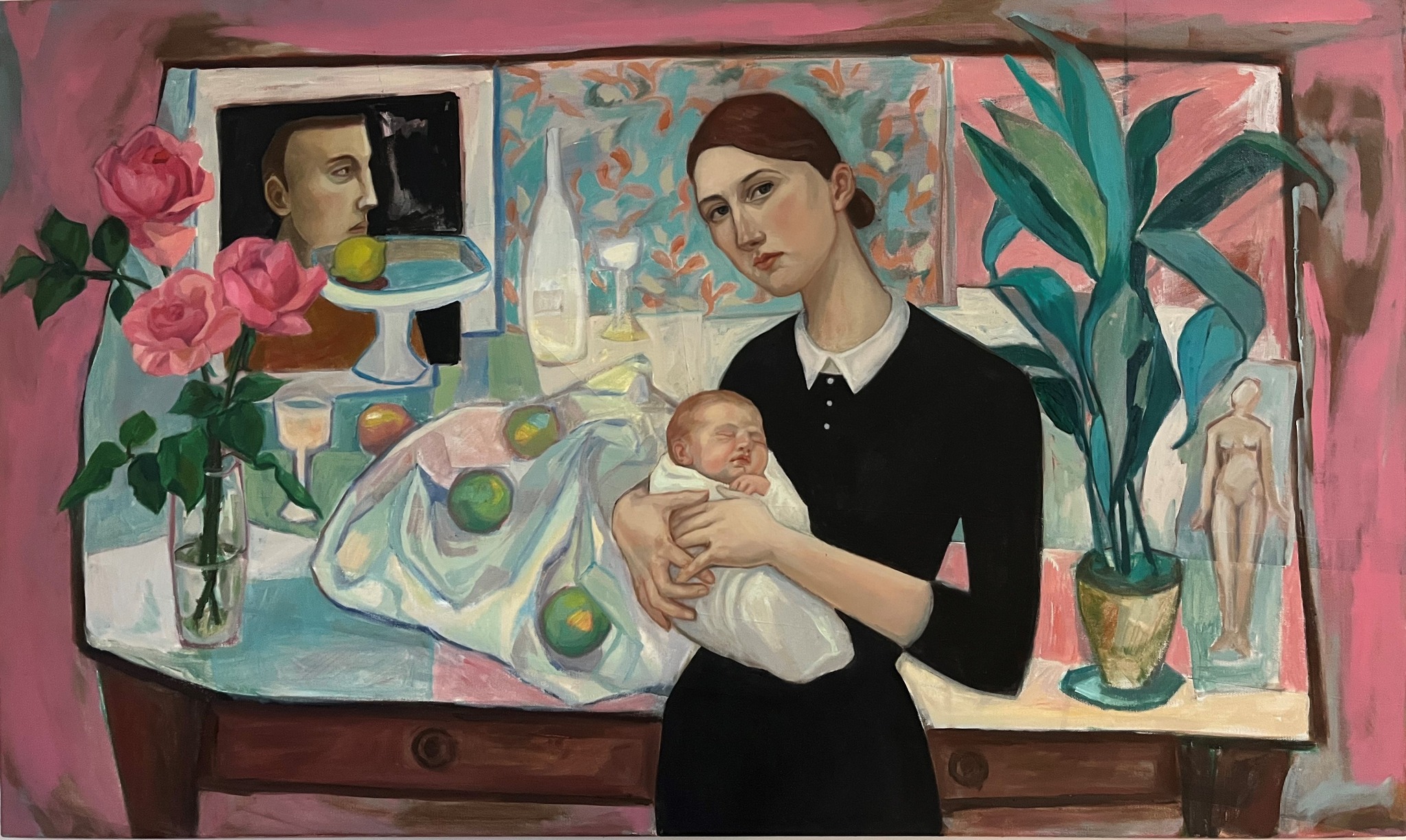
Figures occupy the center of these constructed interiors. Their direct
gaze toward the viewer creates a quiet yet powerful presence that
defines the emotional atmosphere of the paintings. The figure often
appears less as a narrative protagonist than as an almost iconic
presence within the scene. Hands play an important role in this
dynamic. Figures frequently hold objects—an apple, a letter, a toy—or
embrace a child. In compositions featuring mother and child, this
physical contact becomes especially pronounced. Such gestures
introduce a tactile dimension to the space, suggesting intimacy and
attachment within the carefully constructed interior.
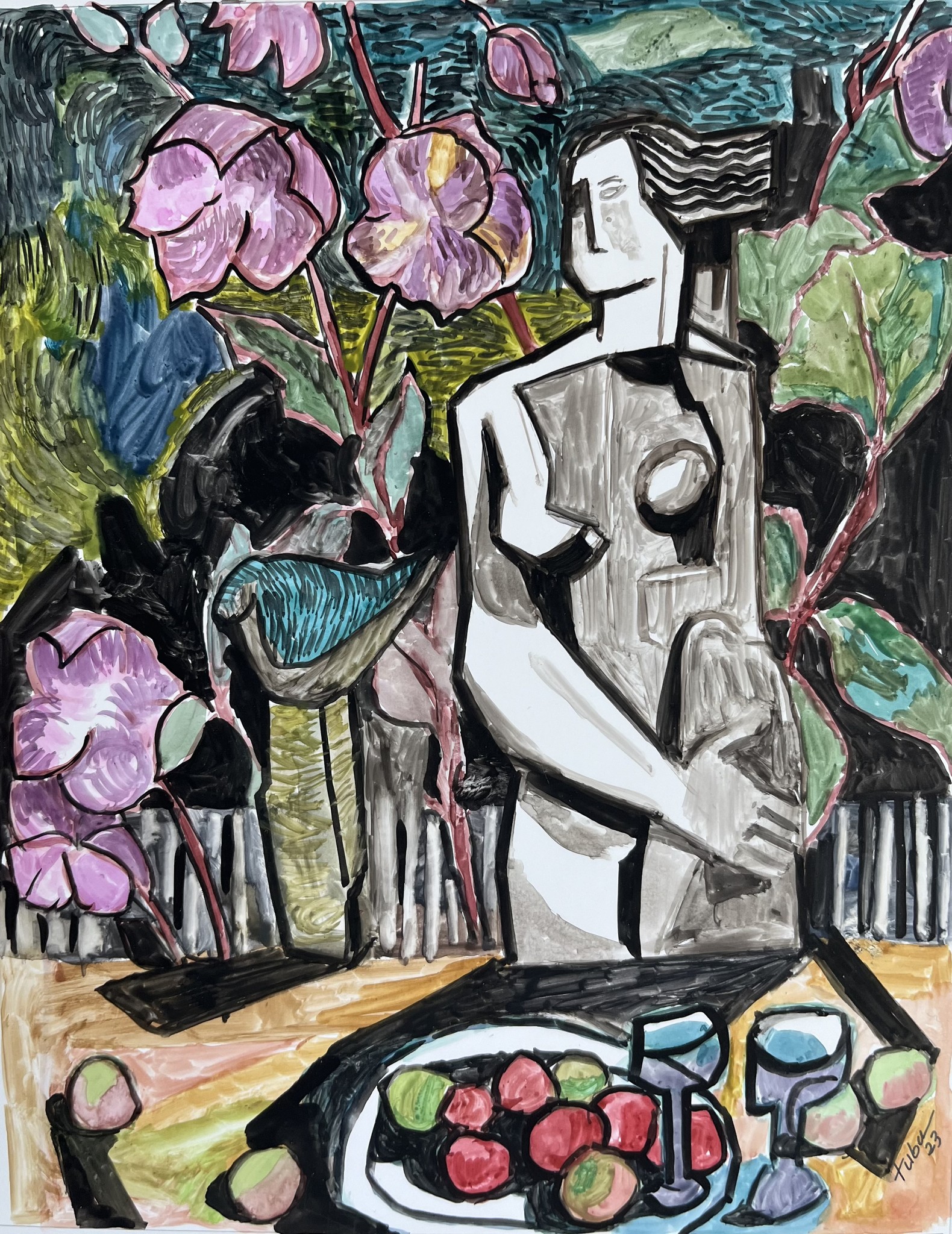
Color is another defining element of the artist’s visual language.
Yellows, pinks, greens, and oranges are applied in matte, flat blocks,
separated by sharp boundaries rather than gradual tonal transitions.
This planar approach resists the illusion of depth and instead
transforms objects into emblematic forms. In many works on paper, bold
black contours reinforce this flatness. The line does not merely
describe form; it acts as a structural element that establishes a
deliberate distance between the painted image and empirical reality.
Although Öztopçu’s paintings resonate with aspects of the modern
tradition—the decorative surface of Henri Matisse, the intimate
interior worlds of Pierre Bonnard, the metaphysical stillness of
Giorgio de Chirico, or the contemplative gaze of Paula Modersohn-Becker—her
work ultimately develops a distinct pictorial language centered on
memory.
Within this language, the interior becomes a site of recollection
rather than mere habitation. Objects are no longer simply belongings
but visual carriers of time. Through these carefully constructed
spaces, Tuğba Öztopçu transforms everyday imagery into a meditation on
memory, presence, and the quiet persistence of the past.
Tuğba
Öztopçu: Die Architektur des Gedächtnisses und die Konstruktion
fiktiver Räume
Die Arbeiten von Tuğba Öztopçu eröffnen auf den
ersten Blick stille, intime Innenräume: Tische, Früchte, Spielzeuge,
Fotografien und Pflanzen. Doch diese vertraute Welt von Objekten
offenbart eine eigene visuelle Logik. In ihren Werken wird das
Interieur nicht nur als physischer Raum dargestellt, sondern als ein
Bildfeld geformt von Schichten der Erinnerung. Alltägliche Objekte
fungieren als Träger von Zeit, persönlicher Geschichte und Reflexion.
Im Zentrum ihrer Praxis steht der
fiktive Raum. Objekte, Bilder
und Rahmen überlagern sich, verschmelzen und erzeugen eine „gestapelte“
Erinnerungsebene – wie Dokumente in einem intimen Archiv.
Wiederkehrende Motive wie Holzpferde, Briefe, alte Fotografien und
Äpfel tragen symbolische Bedeutung; Vögel erscheinen als stille
Lebenszeichen. Die Figuren im Zentrum schaffen durch direkten Blick
und körperliche Gesten eine ikonische Präsenz, die Intimität und
Verbindung vermittelt.
Farbblöcke in Matte, konturierte Linien und die „Rahmen
im Rahmen“-Struktur betonen die Planarität, verwandeln Objekte in
Symbole und reflektieren die Schichtung von Erinnerung. Öztopçus Werke
sind eine visuelle Meditation über Gedächtnis, Gegenwart und die leise
Persistenz der Zeit.
Tuğba
Öztopçu : L’architecture de la mémoire et la construction de l’espace
fictif
À première vue, les peintures de Tuğba Öztopçu
présentent des intérieurs domestiques calmes : tables, fruits, jouets,
photographies et plantes. Mais ce monde familier révèle rapidement une
logique visuelle singulière. Dans son travail, l’intérieur n’est pas
simplement un espace physique, mais un champ pictural façonné par des
strates de mémoire. Les objets du quotidien deviennent des porteurs de
temps, de souvenirs et d’histoire personnelle.
Au centre de sa pratique se trouve l’espace
fictif. Les objets, images et cadres se superposent,
s’entrecroisent et créent une mémoire stratifiée, comme un archivage
intime. Les motifs récurrents – chevaux en bois, enveloppes,
photographies anciennes, pommes – portent un sens symbolique, tandis
que les oiseaux apparaissent comme des signes de vie silencieux. Les
figures, par le regard direct et les gestes physiques, instaurent une
présence quasi iconique, suggérant intimité et lien.
L’utilisation de blocs de couleur mate, de
contours affirmés et de la structure « cadre dans le cadre » renforce
la planarité et transforme les objets en symboles. L’œuvre de Tuğba
Öztopçu devient ainsi une méditation visuelle sur la mémoire, la
présence et la persistance silencieuse du passé.
KUNDUZ,
2026